
THE IMPORTANCE OF A “REPUBLIC” — AND WHY WE PLEDGE ALLEGIANCE TO IT.

Benjamin Franklin was once asked which was the best form of government, and he replied: “A Republic — if you can keep it.”
There are reasons a Republic can be lost if it is not vigorously fought for and reclaimed when it is at risk. Those are the truths defining these times.
The history of the stars and stripes flag of the United States is inextricably shared with America’s military, which shares the same birthdate. The American Continental Army was established on June 14th, 1775, two years before the flag was designated.
On June 14, 1777 the Second Continental Congress passed a Flag Resolution officially adopting the stars and stripes, the red standing for hardiness and valor, the white for purity and innocence.
President Wilson issued a proclamation in 1916 establishing the date as Flag Day, and President Truman followed by an Act of Congress officially designating the day as national Flag Day in 1949.
WHY WE PLEDGE ALLEGIANCE TO THE “REPUBLIC”
The pledge of allegiance to the flag was originally penned by Baptist minister Francis Bellamy in 1892. The pledge went through several revisions until the most recent, in 1954, when the words “under God” were added. Congress had officially recognized the Pledge and included it in the U.S. Flag Code in 1942. By the time events of 1945 had passed, and the close of World War II, it had become evident that without the power of God involved, continuity of any nation is questionable. [See this site’s article on “Dunkirk”]

The flag and the pledge are key symbols of the freedom purchased for us thanks to the sacrifice of many. As President Reagan famously stated: “Freedom is never more than one generation away from extinction. We didn’t pass it to our children in the bloodstream. It must be fought for, protected, and handed on for them to do the same.”
As this nation stands at the crossroads of its 250th year of existence, we should consider the words carefully: “I pledge allegiance to the flag of the United States of America, and to the Republic for which it stands, one nation, under God, indivisible, with liberty and justice for all.”

A Republic stands on the shoulders of its citizens. They are the ones called upon to carefully select representatives to support the Constitution, to interpret, write and uphold the laws, and to defend THE PEOPLE.
Elected positions in a Republic are intended to be temporary. This is not a majority rule as is the basis of a technically named “democracy”, wherein minority opinions are blocked out. A Republic is also not a monarchy wherein the people have no voice. Positions in a Republic require due diligence and a commitment to ethics. The Constitution was brilliantly thought out and drafted to achieve the most equitable system ever contrived by man, by men who had learned from, studied and also suffered under the faults of opposite systems.
There are several conditions which erode a Republic. The most dangerous one is public apathy. The delegation of responsibility for the nation leads to abdication of that responsibility to those elected, resulting in the rise of corruption, special interest groups and demagoguery. Ambitious and unscrupulous leaders often use populism, misinformation and deceit to gain power. This results in a self-appointed aristocracy that refuses to be dethroned!
The rise and expansion of media has added fuel to the fire for either good or evil purposes. The larger the population, the more expensive elections become, the more excellent candidates can be choked off for lack of funding. Those who cannot pay to be seen and heard stand no chance or opportunity to serve. This is something our founding fathers could not have foreseen, when the public square was “the media”. In today’s reality, there is more need, and more pressure, for citizens to connect in person with existing and aspiring legislators — attending Town Halls and communicating directly with them and their staff.
There is nothing wrong with power and wealth, when rightly utilized, as for promoting worthy aspiring candidates, but it more often serves as fertile ground for the growth of greed, selfishness and corruption. As long as election to office depends on how much money is spent, we are on a slippery slope. Education has failed to prepare multiple generations for the large responsibilities granted with voting, but that is not within the scope of this article to address.
A fundamental difficulty with a Republic is that its benefits can be undermined by the lack of a central figurehead such as exists in a monarchy. Kings benefit from the tendency of people to worship pomp, splendor and power. It is also easier for a citizen to delegate decisions to others than to add to one’s daily toil with concern for the future. Political parties are useful but also aggravate divisive tendencies, weakening a middle ground for moderates. This is precisely what makes the Constitution so important.
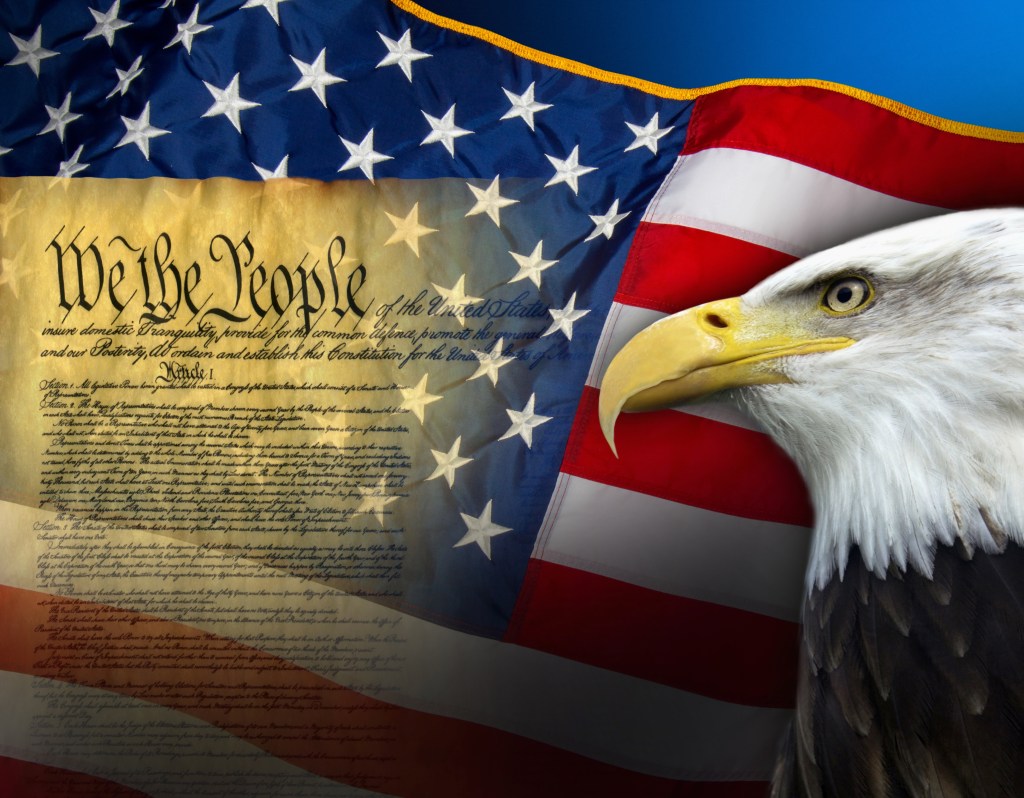
The Constitution is “king”! It holds the final voice, with carefully crafted terms for modification if and when warranted. It survives the turnover of Administrations. It is the lighthouse in the storm, the central pillar by which to filter and analyze legislation and pertinent judiciary actions. This is why attacks on the Constitution increasingly gridlock the U.S. Supreme Court, as many of the lower Courts lack the will or discernment to render the right decisions at lower levels.
2026 is a pivotal and defining year for the Republic of the United States. The question is: “Will we keep it?” It is teetering at this time. Can we save it?
©Copyright 2026 Nancy Diraison/Diraison Publishing. All Rights Reserved. Respectful sharing permitted only with full credit to the source.
Photo credits from Dreamstime:
Featured image: Soldier with flag: ID 105184264© Cateyeperspective| Dreamstime.com
Father and child celebrating liberty: ID 149546350 © Konstantin Iuganov | Dreamstime.com
Flag in the wind: Proprietary.
250th: ID 449306465© Yuliia Koltukova| Dreamstime.com
Eagle/Flag/Constitution: ID 42031934© Steve Allen| Dreamstime.com

